
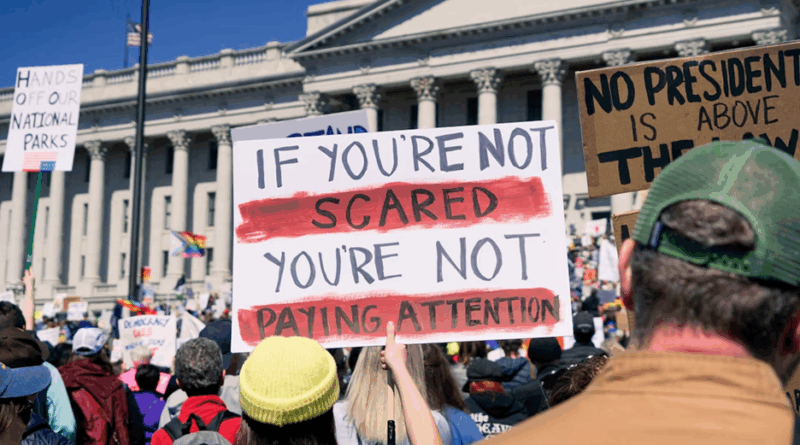
Your Finances Under Fascism
Historians waffle on whether fascism follows a specific economic policy. This is because it’s hard to nail down whether any political ideology follows a specific economic policy. Democracies have wildly different economic policies, as do monarchies, anarchies, theocracies, and many other “-cies” throughout regions and history. The difference I’m highlighting here is that “economic policy” does not mean “personal financial well-being”. Your finances under fascism will tend to be the same as what others have experienced before.
Those are two distinctly separate terms. For personal finance, fascism will only benefit a few, and only in the short term. For everyone else, including future generations, it has a big negative impact. And it’s now past time to prepare (more than just) your financial strategy for it. So what better topic to publish on Halloween 2025 than the most immediately horrifying topic of the times?
There was only one period, in all of United States history, when Americans lived under rule that approached fascism. That time was in the mid-1800s, specifically in the Civil War era. I say “pseudo-fascism” as this time only fulfills most of the definition of fascism. Post-reconstruction South did not have a dictatorial leader, which is a hallmark of fascism. That said, it sure did have many other characteristics, as seen from this handy list from the US Holocaust Museum gift shop:

You may notice that this list can very well describe America in 2025.
Given the many, many alarm bells that have been going off with incessant frequency, it would behoove my readers to have solid plans in place for how they will manage under fascism no matter what. I’m taking lessons from mid-1800s Southern states and mid-1900s Germany to suss out what history repeating itself today will have in store.
So what impacts to your finances under fascism should you be aware of? I’ve compiled a list of possibilities below; while I won’t say which ones are definitely going to happen, you should be aware one or more will eventually be an unavoidable part of your life.
Potential Impact 1: War
The United States has been in a near-perpetual state of war for decades. The difference under fascism would be that war becomes inescapable. At best, the only impact is rationing goods so more can be available for the war effort. The US last experienced en masse in the 1940s. This was already a threat this year had Trump’s tariffs taken effect. That tariff scare very quickly showed what the impact of rationing would have on the stock market. A dramatic drop in value across the board almost sent us into an official recession.
Kiss any hope of a long bull market goodbye.

The impact of war, at worst? To answer this, I highly recommend reading up on William Tecumseh Sherman. He was a rather ferocious Union general during the United States Civil War. When he wasn’t dropping hard-hitting quotes about the reality of war (two of which I’ve pasted below) he was bringing about the total collapse of Southern infrastructure with as little civilian impact as possible.
One of his most insane achievements was capturing Atlanta, Georgia for the Union in September 1864. After doing so, he ordered all civilians to immediately evacuate the city. City leaders sent requests on the contrary; evacuating would be hard for children, the elderly, and those with disabilities. No one wants to leave their homes behind. To which, Sherman replied too bad, so sad. He wanted the war over as quickly as possible; that was not going to happen until he brought down the consequences on everyone:
You cannot qualify war in harsher terms than I will. War is cruelty, and you cannot refine it; and those who brought war into our country deserve all the curses and maledictions a people can pour out.
Sherman then proceeded on his March to the Sea. He followed that by guiding Union troops up into the Carolinas and wreaking property annihilation along the way. Civilians in another wartime may escape with their physical safety, as they overwhelmingly did with Sherman. Should that happen, they still will experience displacement and their property and possessions severely damaged.
… And count their lucky stars they will still spared more:
“I confess, without shame, I am sick and tired of fighting—its glory is all moonshine; even success the most brilliant is over dead and mangled bodies, with the anguish and lamentations of distant families, appealing to me for sons, husbands, and fathers… tis only those who have never heard a shot, never heard the shriek and groans of the wounded and lacerated… that cry aloud for more blood, more vengeance, more desolation.”
Potential Impact 2: Your Investments Lose Value
I’m gonna be brutally realistic here. If history is dead-set on repeating itself in lock step with 1930s Germany, your investment portfolio is going to go up for the next 2-3 years, potentially up to 5. I base this on Germany’s GDP throughout the Great Depression decade. From 1933 (when Hitler was first elected) to 1942, Germany’s GDP gross growth more than doubled from $15.69 billion to $34.07 billion. GDP per capita shares the same story, going from $237.67 in 1933 to $481.20 in 1942.
For reasons I dearly hope are obvious, that economic growth went down in the 1940s once the consequences of authoritarianism caught up to them. So – if you’re able to go live in a different, safe country for awhile and have something invested in an index fund – your finances under fascism will be solid for a time. At least, until the guaranteed consequences come to shake things up on the global economic scale.
Potential Impact 3: Roll Back on Your Rights – Including Property Rights
The Southern states in the 1800s were only overall good for you if you had the right skin color, religion, ethnic background, gender, sexuality, political beliefs, social class, and, of course, a high amount of money. The same went for Germany less than a century later; the only differences lay in which groups with the “wrong” characteristics got the most blame.
These groups were not only falsely painted as homogenous villains. They also underwent attacks on their rights to property protection and overall safety.
“But that wouldn’t happen in the land of the free!” Well, that is also what many Jewish Germans believed throughout the 1930s. It was the same mistaken line of thinking from the higher-ups of the Democratic Party, which I’m pasting from the Sydney Jewish museum website:
They believed that the Nazi regime might not remain in power for very long; an illusion also shared by many non-Jews at the time. The belief that a rapid return to democracy would restore the German-Jewish co-existence deterred many from leaving Germany and rebuilding their lives in other countries.
This was followed by this chilling statement: “It ultimately took a direct threat to their lives to make most German Jews realise that their ties to Germany were no longer a safety blanket.”
It costs money to maintain your well-being. The less rights you can rely on, the more vulnerable you and your money become.
Potential Impact 4: Seizing Your Assets – Including Investment Assets
If you have significant wealth, what guarantees do you have that wealth will not be forcibly taken from you? Which I include here because, despite what the Reddit r/financialindependence mods would have you believe, politics is a fundamental cornerstone of financial independence. Under fascism, you will likely see gains to your investments for a while… as long as you simultaneously retain your rights to those investments.
The United States, historically, is far from batting a thousand. Women did not have full financial rights until the 20th century; it took until the Equal Credit Opportunity Act in 1974 to formally enshrine a woman’s right to credit into law. Before this time, women were largely left to either rely on the men in their lives for this or limit themselves to small local networks. People of color similarly had little recourse when they tried to purchase property. Redlining ran rampant before the 1968 Fair Housing Act established enforcement against it.
Both pale in comparison to more egregious mishaps. Anti-Japanese sentiment in the 1940s paved the way to confiscate the property assets of several Japanese-Americans. Interestingly, these property confiscations largely centered in Southern California, which, today, has some of the most valuable real estate in the country; places with a higher concentration of Japanese-Americans, like Hawaii, mysteriously did not see the same amount of seizing of their less-coveted assets.
As for investments protected behind the eagle seal? Well, authorities have been known to lose track of whatever money you are rightfully owed and entitled to. With little to no restitution, at that, as the rightful recipients of the Indian Trust Fund were to discover.
All of this happened in times the US enjoyed less division and a more secure democracy. Can you confidently say you will not befall the same fate?
Potential Impact 5: Erode Due Process
Say you avoid potential impacts 3 and 4 on this list. Your investment portfolio, along with your rights to property, remain untouched by authorities. Will that last should you get robbed and have no justice system to turn to?
Judicial courts get kneecapped under fascism. This makes it harder, if not altogether impossible, to find help as a victim of a crime. If your paychecks get garnished by your employer, you better hope he’s not friends with the judge. In the event your identity is stolen, sure would suck if your bank won’t face serious problems when your accounts are drained of every penny. Should someone claim your house belongs to them, thoughts and prayers that you’re not seen as the “lesser” person in the dispute that doesn’t deserve to be heard.
Potential Impact 6: Job Opportunities Dry Up
Think you’re safe as a straight white man with in-demand skills? Well, can you guarantee all parts of your ethnic background have never been an excuse for discrimination, and never will be? That your skills won’t degrade with a debilitating illness, or made obsolete by new technology like AI? Do you have a community united enough to help you in your hour of deepest need?
All of these questions are worth thinking about in the era of defunding all of the paltry social safety nets America has in place. The less the poorest Americans can afford, the less money goes into local economies. The less local economies can participate in broader networks, the more those networks are going to see negative effects on their bottom line. The higher those negative effects, the more layoffs will loom. Compound interest is a wonderful part of managing your finances; compounded effects on your employment and lifetime earnings, not so much.
Potential Impact 7: Unable to Afford Certain Goods
I touched on this when discussing rationing for the war effort. The less in-demand goods are available, the more the price rises. The United States is a huge country, but capitalists didn’t build it to be self-sufficient. I mean that very pointedly: Americans spend more on consumer goods than any other country on the planet. Consumerism relies on cheap goods as a gateway for you to keep purchasing more and more expensive crap you do not need.
Fifteen years ago, the financial independence movement, at its core, had a foundation built on frugality. Prioritize your biggest needs and desires in life; that way, you can ruthlessly cut out everything else that is sucking your disposable income without returning enough satisfaction. I believe this frugality focus will see a revival. This won’t be because of a grand educational push, but because there won’t be much of a choice when it comes time to pay the grocery bills. Food prices have already shot up by over 30% since 2019, which only counts the average increase. How much higher can prices go until it breaks your budget?
Your Finances Under Fascism: Not Even Once
I’m going to add one more historical example of fascism here to better explain how long this may last. A particular country out there spent several decades under fascist rule. It only ended after their dictatorial leader passed away; that’s when the political elites signed a pact to forget all of that was ever part of their history. They should just move on and not confront it, going so far as to have zero accountability for those sent into exile, to labor camps, or to their deaths.
That’s not a thought experiment. All of that actually happened. That country was Spain; that dictatorial leader was Francisco Franco; his reign lasted almost forty years; and that pact was literally called The Pact of Forgetting (or Pacto del Olvido, in Spanish). It took a hell of a lot to improve economically post-fascism, yet Spain still wrestles with high unemployment rates today.
In a comment on an earlier article, I wrote that I wished I had some surefire, widely applicable advice on how to survive a fascist state with your wealth and sanity intact. The FIRE investment strategy I advocate so strongly for is only as effective as it is because our constitutional rights prop up our economic prosperity. The most I can do is refer to what survivors of war did to endure their own horrifying circumstances.
Ten years ago, none of this would have been a concern to me. Now, I am asking myself these hard questions so I can stay prepared for whatever may come. Keep your money up, but keep your safeguards up, too. Fascism is never a long-term winning strategy.
Cover image credit: Mike Newbry via Unsplash
Hey! I’m curious what is your net worth at now? The market went up so much since your last post and you were so close to FI so I thought that this is gonna be a net worth update post.
Hi Anonymous! My net worth is about $667k as of this weekend; it makes me >90% FI, so I’m getting close! You can read up on my latest with FIRE via my overall recap from last month, starting with the “My FI Number” section: https://wewantguac.com/my-investing-strategy-and-full-financial-picture/
Thanks for this post. I wish more people were talking about this.
I’d love a post about the possibility and practicalities of parking money overseas (Swiss bank account etc).
You’re in luck! I wrote an article about banking internationally here: https://wewantguac.com/international-banking-open-for-the-average-joe/
I love your content Darcy, even though we differ in terms of political outlook. I think there is less than a zero chance that any president will have the ability to permenantly alter the country’s economy or freedoms. The constitution strictly limits the executive branch’s power and the independent courts have always enforced that. They can pick and choose which crimes to focus on, one administration may be hell bent to go after people who don’t have valid visa status while another may be all over hate crimes. But they only get two terms and it generally swings back the other way. I haven’t been crazy about any of the last few presidents’ performances, yet my personal economy prospered under all of them, because they just lack the ability to interfere with my life to any significant degree. I may have my head in the sand, but even the most extreme presidents, from either end of the spectrum, don’t scare me much.
Hi Steve, I’m glad to explain my perspective further as to why it really is this dangerous to have fascists in office. You’re correct that the Constitution was written to allow a balance of power between the legislative, executive, and judicial branches. At this point in time, however, there legislative and judicial branches are failing to enact serious consequences against the executive branch for gross overstepping of power. President Trump has already permanently damaged the power and security of the United States with outrageous executive orders that froze foreign aid, fired federal prosecutors involved with investigating his criminality and that of his rioting supporters, and provided access to the financial data of US citizens to Elon Musk’s Department of Government Efficiency (source). While there are lower courts temporarily blocking certain measures and several lawsuits filed, this does not roll back the damage already inflicted from unlawful executive orders left to go into effect for any period of time. Just ask any of the residents and citizens who have been arrested, injured, and/or disappeared by masked ICE officials throughout the country acting on his orders (source and source).
In response to “my personal economy prospered under all of them, because they just lack the ability to interfere with my life to any significant degree”: … your personal economy prospered under all of them precisely because of the policies undertaken by government authorities and other federal powerbrokers. Reaganomics kickstarted the trend after the stagflation of the 1970s and Washington has propped up big business ever since. Heck, most of the obituaries about Dick Cheney discuss his aid in supporting sweeping policies that overwhelmingly favor corporations and stakeholders when they’re not discussing his outsized impact on foreign aid policy (such as NYT’s obit here). The Obama and Biden administrations similarly helped businesses with recession bailouts and PPP loans, respectively, and of course Trump is very pro-business. Your own work and intelligence has taken you far as an investor and as a past executive at a Fortune 500 company in Arkansas. But to believe the government policy hasn’t significantly helped boost your access to such success is indeed putting your head in the sand, I fear.