
Drive (less than) the Speed Limit to Save Big
In the era of cars being more expensive than ever before, I have one very easy solution for lowering costs: DRIVE NO MORE THAN THE SPEED LIMIT.
This might just become my most controversial take yet, based purely on observations while driving through the United States this year. Didn’t matter if I was in a heavily congested thruway or backroads in the Dakotas; the average driver prioritizes speed over all else, and that is burning a serious hole in their pocket.
If there’s any time to go a little less than the speed limit, 2026 is IT. Across the board, car insurance rates are going up. It’s harder than ever to find good and honest mechanics due to a severe shortage for auto technicians. And the US aggression against Iran has affected the oil trade so badly that gas stations provide inferior gasoline for higher prices and worsening air quality. Usually, my writing style stops offering examples after the third one; the associated costs of car ownership are so extensive that I need to mention everything from car repairs to motor oil are also rising skywards.
The cost of living crisis compounds ever more.
You need to find ways to save money now if you want to keep car ownership costs under control. And you can ease some of this burden immediately by just easing off the gas pedal. That’s it.
I’m speaking from experience. About four years ago, I was driving back to New England from Canada. I was determined to put off stopping at a Canadian gas station for as long as possible, since U.S. prices were much better. To my surprise, driving 60mph got me over the border without needing to stop for gas at all. That lesson has ensured I pay much less for gas ever since. And this summer, researchers from the University of Minnesota proved me empirically correct:
Why Speeding is So Prevalent
That lesson I’ve applied to my driving ever since has not permeated American consciousness. Speeding is normalized; it is wholeheartedly accepted without question.
Part of this is, from what I can tell, due to the belief that maintaining the same speed as traffic is safer than obeying the posted speed limits. It only takes one speed demon behind the wheel to spark up the adrenaline of every other driver. A few months back, my friend Sam messaged me about this. At the time, he was driving back and forth to an office for a clinical trial and shared his perspective:
It’s about a 3.25 hour drive. I frequently find myself driving 75. Not because I’m in an especially big hurry to get there or get home, I just feel like I’ll get run off the road if I drive slower.
Which, totally understand that viewpoint! Nobody wants to get into a car accident, so driving a little faster to keep up with the flow of traffic seems less risky.
I asked a few other friends their perspectives on speeding. Purple from A Purple Life agrees with Sam:
In general, I’m against speeding and didn’t go over the speed limit until like this year. Now, to keep up with the flow of traffic, I will go five over on regular roads if people are behind me and ten over on the highway for the same reason. People be wild in rural areas.
I’m guilty of this as well.
I’m well aware that a car can either kill me, severely injure me, or cause thousands of dollars worth of damage to my car. This is at the forefront on my mind when I’m driving the speed limit and someone starts tailgating me for more than a few minutes. Logically, I know speeding regularly decreases your level of safety no matter who’s tailgating you. But it’s hard to apply logic when you realize how easily a tailgating driver can lose patience and simply ram your bumper.
Kitty from Bitches Get Riches lives in an area of New England with a reputation for horrible drivers (Massholes). She brought up that poor road infrastructure absolutely contributes to the problem:
Our roads and cities were built without the benefit of city planners, so we have more irregularities (chokepoints, sudden exits, narrow lanes, salt-eroded lane paint) that indirectly encourage erratic driving. The consequence is that everyone drives with what seems to be hostility, but is actually just aggressive self-preservation. IF you can drive successfully here, you can comfortably drive in any state (save the south during a snowstorm, where other drivers will kill you).
I lived in the Boston area for about a decade, so she’s nailed it here. Her partner, Mr. Kitty, sent me a link to an article on how Boston’s neighbor Somerville lessened the amount of fatal crashes by making cars drive slower. He also told me about Vision Zero Network, which is dedicated to ending all injuries and death from car accidents. One of the biggest struggles they cite is “a long legacy of speed-over-safety policies”. Until our governing structures can do this work themselves, it’s up to individuals to improve things by driving no more than the speed limit.
Why There’s No Avoiding Cars Right Now
A friend of mine very generously agreed to take care of selling my car just before I left the country to go travel. I once again no longer have a car, and this is a fantastic time to go carless. But unless you live with excellent public transit options, you’ll have a hell of a time trying to join me in this.
The U.S. is built around car infrastructure, and there’s no good way around it for most Americans. It’s been a necessary evil for several decades; not even the rise of electric cars can do away with it, as there is not enough infrastructure supporting electric vehicles (EVs) to make long journeys with one feasible.
Besides the amount of time it takes to properly charge them, there aren’t enough EV chargers in the United States to support just anyone getting one. Unless you’re in California, which has 80% of the country’s EV chargers, odds are good an electric vehicle remains too out of reach. For the time being, most Americans have to deal with gas-powered cars for any geographic access at all.
So, for this necessary evil, do the easiest thing to lessen its impact and DRIVE THE SPEED LIMIT.
Why Slower Speed = Serious Savings
Let’s look at the financials first: driving 60 miles per hour (mph) on the highway translates to higher miles per gallon (mpg). There were points on my cross-country trip I was hitting 32 mpg; that’s a heck of a lot of gas savings I did while gas prices were at their most expensive. If you do the math, you’ll see that getting 30mpg instead of 20mpg grants you the equivalent of a 67% discount on gas.
| Miles driven | Average gas price | MPG | Total cost |
| 1,000 | $4.15 | 20 | $207.50 |
| 1,000 | $4.15 | 25 | $166.00 |
| 1,000 | $4.15 | 30 | $138.33 |
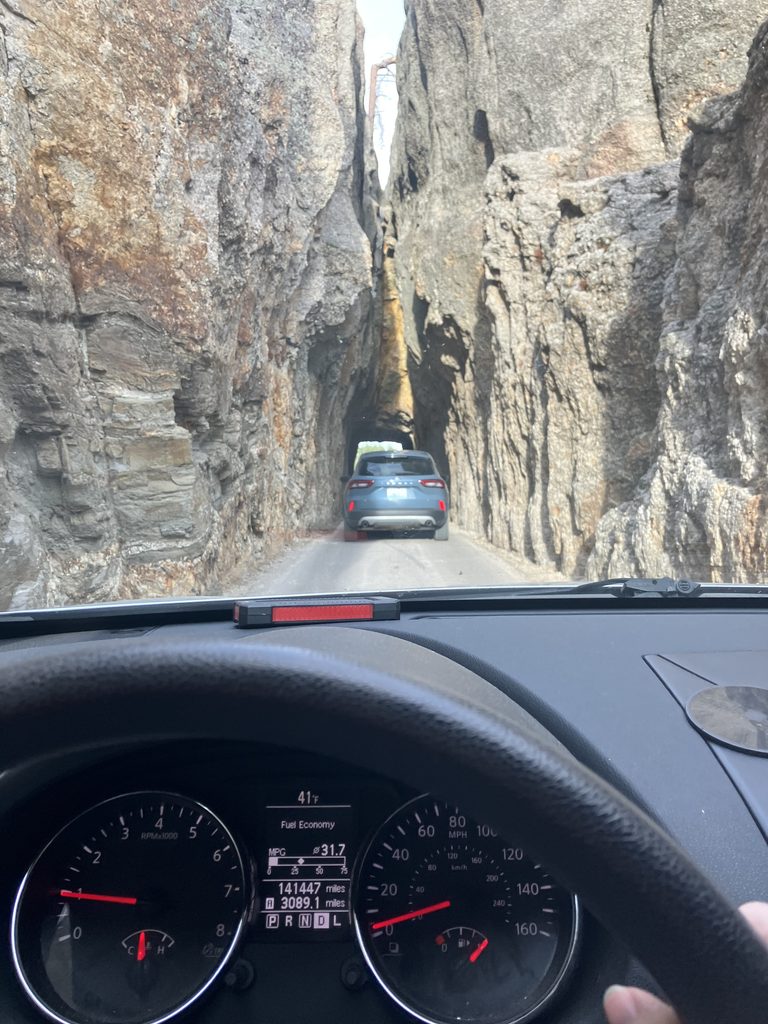
Driving at the speed limit, or less than, also saves you hundreds/thousands in car maintenance costs. Slower speeds means less wear and tear on your car, meaning a lower risk of costly repairs. Tires last longer, brakes last longer, and the engine chugs along for much longer. The check engine light on my 2011 Nissan only came on once in the last five years. And only after I had drive up the West Coast, into Canada, back into the States, and south through several national parks.
An obvious win here is saying sayonara to ever getting pulled over for speeding again. No one likes paying speeding tickets. It’s also just common sense to minimize run-ins with the cops. The only ticket I have ever had to pay, in all my years driving, is a $10 parking ticket in Montpelier, Vermont.
Zero speeding tickets FTW.
Extrapolating this further only makes the impacts more stark. The more people in your community adopt this, the less everyone pays on taxes maintaining the roads. Less road wear = less need for roadwork. America was literally founded because colonists got whiny about paying too much in taxes; it should be a matter of national pride to drive slower so those road systems don’t need as much tax upkeep.
Slower Speeds Offer Non-Financial Benefits, Too!
Just because you’re driving slower, doesn’t mean other drivers will. That is because America has more idiots than ever before. Don’t let their poor decision-making affect you more than it already has. You do this by, once again, driving no faster than the posted speed limit. This gives you a significant edge over those piss-poor drivers: an improved reaction time. That better reaction time can make the needed difference between getting to your destination in one piece, or not.
Even without bad drivers, driving slower helps you react much more easily to bad road infrastructure, sudden weather changes, and wildlife trying to cross the road. I have never contributed to car crash statistics, and appropriate driving is a huge reason as to why. Crazy drivers overwhelmingly pass on by, minimizing risk of others crashing into you
Plus, you get a much-improved driving experience overall. Less stress during your commute and errands means less of a strain on your daily mental load. We’re all stressed out already, and that’s without further stressors on the horizon coming in hot. I’m telling you, you can give yourself an easy win by just DRIVING SLOWER.
What You Lose by Driving Slower
Now let’s talk about downsides to driving slower. Turns out, there’s a lack thereof. The biggest perceived benefit to speeding is saving time. Oddly enough, you don’t actually save time. At least, not enough time to make speeding worth it. A 2015 study found that the average driver did save some time by speeding. How much time? A grand total of… two minutes per week! A whole two minutes, woohoo! Totally worth any and all accident injuries and fatalities, amirite?
I have a video earlier in this article about a study done this year on this same topic. The University of Minnesota dramatically expanded the research parameters of that 2015 paper. They found that driving over the speed limit, on average, saves you a paltry 54 seconds a day. The co-author, Professor Northrup, shared a dryly succinct takeaway:
If your goal is to shave one minute off your time, then you’ve got to drive fast. If your objective is to get to your destination safely and to save fuel, then you might drive slower than the speed limit.
Very nicely put. Just drive slower and you can thank me for the quality of life boost later.
Cover image credit: ME! This was taken in Tacoma, WA.